There I was, eight years old, sitting in the co-pilot seat of a tiny five-seater plane, absolutely convinced I was going to have a great first plane flight. Snow-covered mountains stretched out below me, canyons carved into the earth like something out of a dream. Then the turbulence hit — and let’s just say the pilot’s “emergency bag” behind my seat got a serious workout. Ten times. I counted.
That was my introduction to motion sickness, and it was a memorable one.
Whether you’ve turned green on a winding road, felt the world spin on a choppy boat, or gone pale at 30,000 feet, you know the feeling. The good news? Once you understand what’s actually happening in your body, you can fight back.
The Way Your Brain Works
Here’s the thing about motion sickness — your body isn’t broken. It’s just confused.
Your inner ear is constantly tracking movement and keeping you balanced. Your eyes, meanwhile, are taking in the world visually. Normally, these two systems agree with each other. But put yourself in a moving car while staring at your phone, and suddenly they’re telling your brain two completely different stories. Your inner ear says “we’re moving,” your eyes say “everything looks still,” and your brain — caught in the middle — panics. The result? Nausea, dizziness, cold sweats, and the sudden urge to ask the driver to please pull over.
Things like anxiety, strong smells, poor ventilation, and even just being a little under the weather can make it all worse. Some people are simply more prone to it — children between ages 2 and 12, women, people who get migraines, and those with inner ear conditions tend to feel it more strongly. If motion sickness runs in your family, there’s a good chance you inherited the fun.
The silver lining? It’s not dangerous. The moment the motion stops, your brain figures out it was worried over nothing, and the symptoms fade.
How to Keep the Queasiness at Bay
The best time to fight motion sickness is before it starts. Here’s what actually works.
Pick your seat wisely. In a car, the front seat is your best friend — being able to see the road ahead helps your eyes and inner ear get back on the same page. On a plane, aim for a seat over the wings where turbulence is least felt. On a boat, the center of the vessel is your safest spot. On a train, face forward near a window.
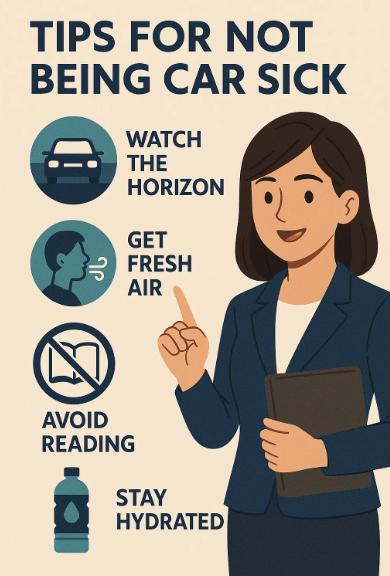
Lock onto the horizon. Find a fixed point in the distance — a mountain, a building, the horizon itself — and keep your eyes on it. Your brain gets the motion cues it needs and the confusion clears up. And whatever you do, put the phone down.
Get some fresh air. Cracking a window or turning on the air vent can make a surprising difference. Stuffy air and strong smells — fuel, food, heavy perfume — are notorious for tipping someone from slightly off to definitely stopping this car.
Eat smart before you travel. A big greasy meal before a road trip is a recipe for disaster. Stick to something light, bring crackers or ginger candies, and stay hydrated with plain water.
Try ginger or peppermint. These aren’t just old folk remedies — there’s real science behind them. Ginger in particular has solid evidence for reducing nausea. Keep some on hand for longer trips.
Apply some pressure. Pressing or firmly squeezing your wrist or hand can redirect your brain’s focus away from the nausea. It sounds odd, but for some people it genuinely helps.
Put on some good music. Your favorite playlist can lift your mood, keep you calm, and give your brain something else to focus on besides how miserable you feel.
When It’s Already Too Late
Sometimes despite your best efforts, the nausea wins. Put down whatever you were reading or watching and focus on something stable in the distance. Take slow deep breaths — your nervous system actually responds to this. Sip cold water or ginger ale slowly. If closing your eyes helps, do it, and even a short nap can reset your system. If you’re in a car, there’s no problem in asking the driver to pull over for a few minutes.
And if none of that helps? Sometimes you just breathe through it, stay calm, and wait. It always passes.
A Lesson Learned the Hard Way
One of my most memorable moments wasn’t on a plane — it was a simple car ride to the library. I knew something was wrong before we even left our neighborhood and I felt terrible. Let’s just say the van floor paid the price. I got car sick as we pulled out of the driveway. I threw up right onto the floor.
My brother’s advice afterward? “You should have grabbed a bag.” He wasn’t wrong.
Now I never travel without a plan — light snack, window cracked, eyes on the horizon, ginger candy in my pocket. Those emergency bags on planes? Let’s just say . . . I am very thankful for them.
The Takeaway
Motion sickness is your brain’s over-enthusiastic response to mixed signals — annoying, sometimes dramatic, but completely manageable. Know your triggers, pick your seat, keep the horizon in sight, and bring ginger. With a little preparation, you can stop dreading the journey and actually enjoy the ride.
Now go plan that road trip. You’ve got this.