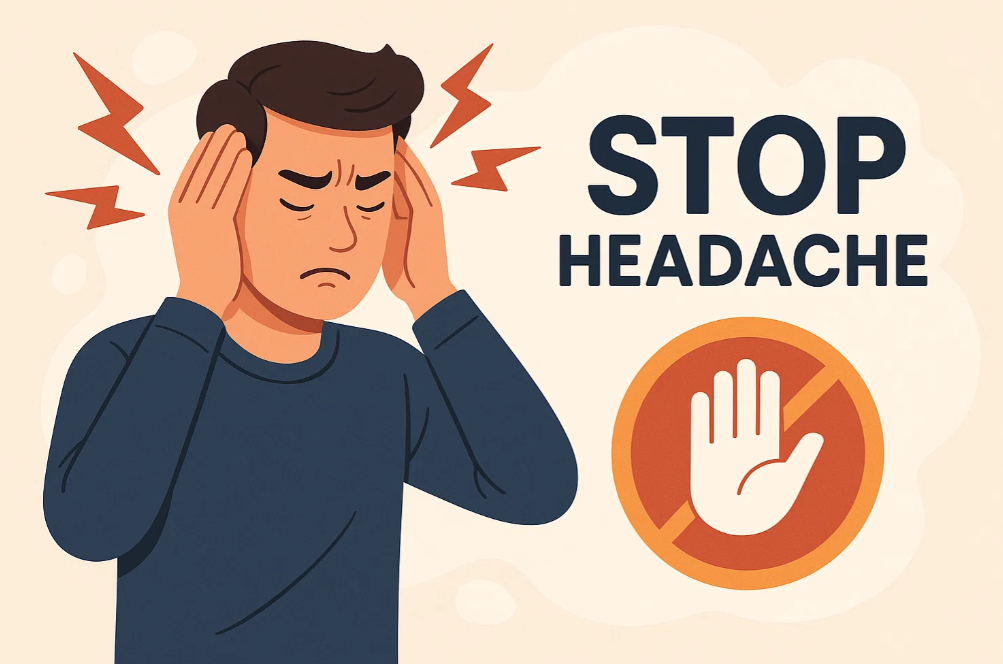
Your Head Is Pounding. Here’s How to Actually Make It Stop.
Most headache advice tells you to “drink water and rest.” That’s not wrong — it’s just incomplete. Here’s a smarter way to figure out why your head hurts and get real relief, fast.
You’ve tried the dark room. You’ve had the glass of water. Maybe you’ve even pressed your thumbs into your temples until it felt like you were trying to push the pain out through your skull. And still — nothing. The headache stays.
The reason most headache relief attempts fail isn’t because the remedies are bad. It’s because people skip the one step that matters most: figuring out why the headache started in the first place. Treat the wrong cause and you’ll spend the next hour on the couch for nothing.
This guide cuts through the jargon. We’ll show you how to identify your headache type in minutes, run through a quick 8-question self-check, and then walk you through the G.O.N.E. method — a straightforward, no-medication-first approach that addresses the root cause rather than just covering up the pain.
Why You Have a Headache (And Why It Matters)
Most headaches fall into one of two buckets: primary headaches, which are the headache itself (like tension headaches or migraines), and secondary headaches, which are a symptom of something else going on in your body. The treatment path is completely different depending on which you’re dealing with.
Here’s a quick breakdown of the most common types:
Tension Headache
That tight, band-like pressure squeezing across your forehead. The most common kind — usually stress or posture-related.
Migraine
Throbbing, often one-sided pain — sometimes with nausea, light sensitivity, or visual disturbances called auras.
Cluster Headache
Severe, stabbing pain around one eye. Often comes in cycles — multiple attacks per day for weeks, then nothing for months.
Sinus Headache
Pressure behind the cheeks, nose, and forehead — typically worse when you bend forward or wake up in the morning.
Caffeine Withdrawal
Skip your morning coffee and pay for it by noon. Caffeine-dependence headaches are real, reliable, and very fixable.
Rebound Headache
Using pain relievers more than 10 days a month? They can actually cause more headaches — a cruel irony called medication overuse headache.
Beyond these everyday types, headaches can also be triggered by dehydration, blood sugar crashes, eye strain, hormonal shifts, high blood pressure, tumors, and even certain medications. The good news: most headaches you’ll experience day-to-day fall into one of the common categories above — and most respond well to non-medical remedies when treated correctly.
Know when to call a doctor. Most headaches aren’t dangerous. But some are warning signs worth taking seriously. Use the SNOOP criteria below — if any of these apply, skip the home remedies and contact a healthcare provider promptly.
The SNOOP Method: When to Take Your Headache Seriously
SNOOP is a clinical screening tool used by neurologists to flag headaches that need medical attention. It’s a useful thing to run through before you reach for the ibuprofen — and a necessary one if the headache feels different from anything you’ve had before.
Clinical screening tool down below;
SNOOP: Red Flags to Watch For
- S Systemic symptoms— fever, unexplained weight loss, or a stiff neck alongside the headache
- N Neurological signs— confusion, weakness, vision loss, or difficulty speaking
- O Onset is sudden— a “thunderclap” headache that peaks in under a minute is a medical emergency
- O Older age at onset— new headaches that begin after age 50 warrant investigation
- P Progressive worsening— headaches that keep getting worse or feel fundamentally different from your usual ones
If none of those apply, you’re most likely dealing with an everyday headache — and you can move on to figuring out the cause.
Treating the wrong headache is like replacing a flat tire when you’re out of gas. — The smarter approach starts with a diagnosis, not a remedy
The 8-Question Self-Check
Before you do anything else, run through these eight questions. Answer honestly — the cause of your headache is almost always hiding in one of these answers:
- Have I had enough water today? (Dehydration is the #1 overlooked cause)
- Am I staring at a screen right now — and for how long?
- Did I sleep enough last night, or did I shortchange myself?
- Are there strong smells nearby — cleaning products, perfume, smoke?
- Am I coming down with something? Fever? Congestion?
- When did I last eat a proper meal?
- Have I had too much sugar or caffeine today?
- Am I cutting back on coffee, alcohol, or anything else I normally consume?
Most people can pinpoint the culprit after this exercise. Once you know the cause, relief stops being a guessing game — and the G.O.N.E. method gives you a concrete plan.
The G.O.N.E. Method: A Smarter Path to Relief
G.O.N.E. is a four-step framework designed to address the most common headache causes in order of simplicity and effectiveness. Work through it from the top — you may be surprised how rarely you need to reach the last step.
G
Get nutrients and hydration in
- Drink a full glass of water immediately — then another
- Eat something with substance: protein, complex carbs, healthy fats
- Try ginger or peppermint tea — both have evidence behind them for headache relief
- If you’ve been on caffeine: a small amount (not a double espresso) can help withdrawal headaches
O
Off the screen, onto your feet
- Step away from your computer, phone, and TV — even 20 minutes makes a real difference
- Do a few gentle neck rolls and jaw unclenches
- Massage the base of your skull, your temples, and the muscles between your eyebrows
- Go outside if you can — natural light and a change of scenery reset your nervous system
N
Nurture your body physically
- Apply a warm compress to your neck and shoulders — heat loosens the muscles that pull on your head
- Try a cold pack on your forehead if it’s a throbbing migraine-type headache
- Put on something calm — ambient music, nature sounds, or silence
- Ask someone to rub your shoulders; muscle tension in the traps is a surprisingly common headache trigger
E
Eliminate triggers and rest
- If nothing else is working: sleep. Even 20–30 minutes can completely reset a mild-to-moderate headache
- Avoid alcohol, sugary drinks, and heavy caffeine while the headache is active
- If you need medication, use it — but consider it a last resort, not a first move
- Be careful with frequent pain reliever use; more than 10 days per month can trigger rebound headaches
Pro tip
Sleep is often the single most effective headache remedy — especially for tension and migraine headaches. If the environment allows, close your eyes for even 20 minutes before reaching for pain medication. Many people wake up and find the headache has resolved entirely.
A Few Things Worth Knowing Before You Go
Pain medication — ibuprofen, aspirin, acetaminophen — is safe and effective when used appropriately. The goal of this guide isn’t to tell you never to take a pill. It’s to remind you that most everyday headaches have a fixable cause, and that treating the cause is faster, more reliable, and better for your long-term health than relying on medication every time your head hurts.
If your headaches are frequent (more than two or three a week), getting worse over time, or disrupting your daily life, it’s worth talking to a doctor. Chronic headache has real treatment options — and no one should just white-knuckle through it.
Start with the 8 questions. Work through G.O.N.E. Give yourself 30 minutes. Chances are, your head will feel a lot better before you hit the bottom of the list.
Sources: American Headache Society; International Headache Society Classification (ICHD-3); National Institute of Neurological Disorders and Stroke.
Disclaimer: This article is for informational purposes only and does not constitute medical advice. Always consult a qualified healthcare provider for diagnosis and treatment.